

Insights into AI's Role in Financial Services
AI Transforming the Financial Landscape
This page provides a biweekly roundup of AI related news concerning US financial services including banking, capital markets, fintech, and corporate finance. Discover how artificial intelligence is reshaping banking, and capital markets driving innovation and efficiency across the financial sector.
X9 AI Study Group Newsletter - Issue No. 18 (2026)
Bipartisan Senators Propose Federal Oversight for Advanced AI
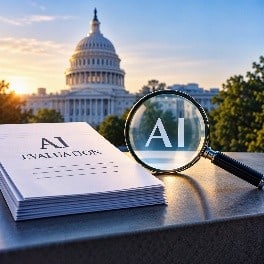
Sens. Josh Hawley and Richard Blumenthal introduced the Artificial Intelligence Risk Evaluation Act of 2025, which would create a federal evaluation program for advanced AI systems before they can be deployed in interstate or foreign commerce.
The proposal would place the Department of Energy in charge of a testing framework that includes red-teaming, third-party evaluations, and safety assessments of model training data and model weights. The program is intended to identify risks to national security, public safety, and civil liberties before deployment.
Only the most advanced AI models, defined by a computing threshold, would be subject to the requirements. Developers that deploy covered systems without completing the evaluation process could face penalties of up to $1 million per day.
State Supervisors Formalize AI Examination Approach
The Conference of State Bank Supervisors (CSBS) released an AI Supervisory Framework designed to help state regulators evaluate how banks and nonbank financial institutions use AI.
The framework provides examiners with structured questions and a risk-based approach for assessing AI deployments, governance practices, third-party dependencies, and potential consumer impacts. It is intended to promote more consistent supervision while helping institutions understand the types of information and controls regulators may expect during examinations. The framework does not create new regulations but offers guidance for incorporating AI into existing supervisory processes.

Fed Proposes Stablecoin Rules Under the GENIUS Act
The Federal Reserve proposed new rules to implement stablecoin provisions established under the GENIUS Act.
The proposal would create a supervisory framework for payment stablecoin issuers, including requirements for reserve backing, risk management, governance, and operational controls. Fed-supervised banks seeking to issue stablecoins would be required to submit applications and supporting information for regulatory review. The framework is intended to address credit, liquidity, and operational risks while providing regulatory clarity for financial institutions exploring stablecoin issuance.
The proposal represents a significant step toward integrating stablecoins into the regulated U.S. financial system and establishing formal oversight for their use in payments and other financial services activities.

Banks Release Principles for Building Public Trust in AI Agents
Six major banks, including Bank of America, Capital One, ING, NatWest, ASB Bank, and Commonwealth Bank of Australia, released a set of principles aimed at building public trust in AI agents that can act on behalf of consumers in commercial transactions.
The principles focus on transparency, safety, privacy, user choice, and interoperability, addressing concerns about how AI agents will make purchases, access data, and handle financial decisions. The initiative reflects growing industry recognition that trust, governance, and accountability will be critical as agentic commerce evolves from concept to reality.

NIST Launches New Path for AI Standards Development
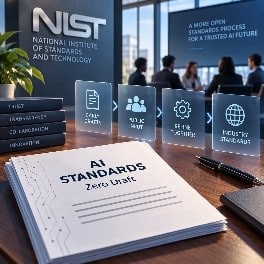
NIST launched a new AI Standards “Zero NIST launched a new AI Standards “Zero Drafts” pilot program aimed at accelerating AI standardization and broadening stakeholder participation.
Under the approach, NIST will publish early draft concepts, gather public feedback, and then help transition mature work into industry-led standards development processes.
The first Zero Draft focuses on public-facing AI documentation, offering guidance and templates for describing AI models, datasets, governance, and risk information. NIST hopes the process will shorten standards-development timelines while improving transparency and collaboration among government, industry, academia, and standards bodies.
NIST Releases Summary of Comments on Software and Agentic AI Identity Concept Paper
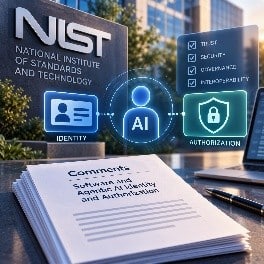
NIST’s National Cybersecurity Center of Excellence (NCCoE) published a summary of feedback received on its Software and Agentic AI Identity and Authorization concept paper.
The comments highlight growing industry interest in how AI agents should be identified, authenticated, authorized, and governed. Respondents emphasized challenges such as establishing trust, defining appropriate authorization models, ensuring accountability, and supporting interoperability across systems.
NCCoE announced that software development will serve as its initial implementation use case, helping demonstrate practical approaches for managing AI agent identity throughout the software lifecycle.
Meta Expands Muse AI Agent to Small Businesses
Meta announced Muse for Small Business, expanding its AI agent platform to help small businesses manage operations, attract customers, and complete tasks across existing business tools.
Muse integrates with platforms including Shopify, QuickBooks, Stripe, Slack, Zoom, Notion, Canva, Dropbox, Facebook, and Instagram, allowing it to understand a business’s products, customers, and workflows.
Meta positions Muse as an AI agent that can help business owners save time by handling routine tasks while requiring user approval before publishing content, sending communications, or spending money.

Introducing dots
OpenAI introduced dots, always-on AI agents designed to work continuously on a user’s behalf rather than responding only when prompted.
Powered by GPT‑6 Astra, each dot operates on its own cloud computer, can connect to more than 4,000 applications, and learns from user feedback over time. Users can interact with dots through ChatGPT, Slack, or Teams, inspect their work, and control what actions they may take independently.
OpenAI also previewed enterprise-focused specialist dots with their own identities, access-management credentials, and deeper integration into business systems.

Stay Ahead in Financial AI
Subscribe to our newsletter for the latest insights and updates on AI in financial services.
Archive of Newsletters
AI and Financial Services Insights
- AI Newsletter – Issue No. 16 (2026)
- AI Newsletter – Issue No. 15 (2026)
- AI Newsletter – Issue No. 14 (2026)
- AI Newsletter – Issue No. 13 (2026)
- AI Newsletter – Issue No. 12 (2026)
- AI Newsletter – Issue No. 11 (2026)
- AI Newsletter – Issue No. 10 (2026)
- AI Newsletter – Issue No. 9 (2026)
- AI Newsletter – Issue No. 8 (2026)
- AI Newsletter – Issue No. 7 (2026)
- AI Newsletter – Issue No. 6 (2026)
- AI Newsletter – Issue No. 5 (2026)
- AI Newsletter – Issue No. 4 (2026)
- AI Newsletter – Issue No. 3 (2026)
- AI Newsletter – Issue No. 2 (2026)
- AI Newsletter – Issue No. 1 (2026)
- AI Newsletter – Issue No. 7 (2025)
- AI Newsletter – Issue No. 6 (2025)
- AI Newsletter – Issue No. 5 (2025)
- AI Newsletter – Issue No. 4 (2025)
- AI Newsletter – Issue No. 3 (2025)
- AI Newsletter – Issue No. 2 (2025)
- AI Newsletter – Issue No. 1 (2025)