

COMPLIANT WORKFLOWS How to satisfy regulatory requirements, automatically
THE CHALLENGE Off-the-shelf workflows will not deliver compliance
Legal order workflows are not generic business processes. Every levy, subpoena, garnishment, and civil court order triggers a chain of legally required steps, each governed by federal statutes, state laws, agency-specific procedural rules, and your institution’s own compliance policies. Miss a step, miss a deadline, or send the wrong response format, and the result can range from a motion to compel to direct legal liability.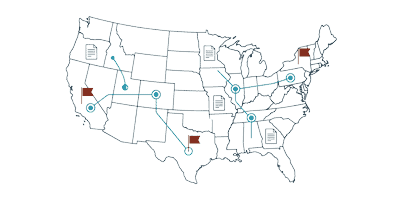 CHALLENGE 1:Jurisdictional Complexity
Garnishment exemptions, RFPA (Right to Financial Privacy Act) restrictions, BSA (Bank Secrecy Act) disclosure rules, and response deadlines all vary by state, order type, and issuing authority. A single generic workflow cannot serve them all.
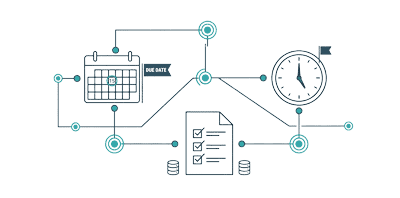 CHALLENGE 2:Time-Bound Requirements
Legal orders carry hard statutory deadlines. A garnishment must be answered within days. A subpoena may require a certified response with a chain-of-custody audit trail. Delays are not just operational; they are legal exposure.
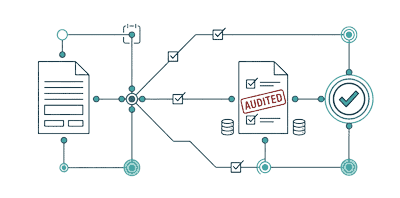 CHALLENGE 3:Audit-Ready Documentation
Every decision in the workflow (holds applied, exemptions invoked, payments processed, responses sent) must be documented in a format that can withstand internal audit, regulatory examination, and legal challenge.
THE SOLUTION Your workflows need to be engineered for legal order compliance from the ground up
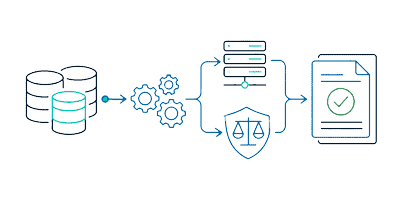
Your workflows need to be built around the actual legal and procedural requirements of each order type, not adapted from generic BPM (Business Process Management) tooling. Every step should be designed to comply with the full complexity of real-world requirements: point-in-time and continuous garnishments, two-step payment processes, timely BSA data pushes, RFPA certificate and exemption compliance, disclosure-prohibited confirmations, and legally compliant answer delivery.At every stage, your system needs to generate audit-ready reporting to satisfy internal policy and regulatory oversight. No additional manual documentation steps should be required.
ORDER TYPES YOU WILL NEED TO SUPPORT Each workflow will need to be purpose-built for its legal context
Levies & Garnishments
- Point-in-time and continuous garnishment flows
- Seizable funds calculation
- Two-step payment processing
- RFPA exemption compliance
- Automated zero-paper levy processing
Subpoenas & Document Requests
- Account search and record retrieval
- Certified response packaging
- Disclosure-prohibited confirmations
- Chain-of-custody audit trail
- Timely BSA data push
Civil Court Orders
- Jurisdiction-specific response rules
- Standardized answer generation
- Exemption logic by state law
- Multi-defendant handling
- Court-compliant response formats
Other Legal Orders
- ISRNs and information subpoenas
- Tax levies (IRS, state agencies)
- Bankruptcy notifications
- Litigation holds
- Expandable via workflow engine
National standards like X9.129 and X9.144 transform legal orders into electronic structured data. Interpreting that data correctly, respecting jurisdiction-specific rules, and delivering legally compliant responses in a standardized format demands deep workflow intelligence and legal engineering that no general-purpose platform can provide.
STANDARDS FLUENCY Your workflows should be built around X9.129, X9.144, and what comes next
Your workflows should be designed around the national standards that define electronic legal order processing. Members of your team should participate in the X9B4 Legal Orders Workgroup, which is actively defining forthcoming formats for electronic legal orders standards. Your workflows will not just be compliant with today’s standards; they will be shaped by the people writing tomorrow’s.INSTITUTION-SPECIFIC COMPLIANCE Your policies should be encodable directly in the workflow
No two institutions interpret their compliance obligations identically. Your workflows should be configurable so your institution can encode its own legal interpretations and policies (from when CFPB (Consumer Financial Protection Bureau) regulations apply to how exemptions are handled under specific state laws). Your workflow should follow your rules, not probabilistic assumptions.WHY COMPLIANT WORKFLOWS ARE THE BACKBONE OF YOUR ZERO-PAPER AUTOMATION STRATEGY
Reduce Legal Exposure
Every required step executes in sequence, on time, with full documentation; this eliminates the compliance gaps that create motions to compel and regulatory findings.
Scale Without Headcount
Workflows that run automatically handle volume spikes without proportional staffing increases, freeing your team to focus on exceptions, not execution.
Audit-Ready by Default
Every hold, exemption, payment, and response should be logged automatically, so your team is prepared for internal audits or regulatory examination at any time.
REQUEST TO JOIN THE LEGAL ORDER ROUNDTABLEAct now (at no cost) to stay ahead of the curve
MEMBER BENEFITSAccess exclusive resources, events, and discussions
Despite the promise of AI, full automation will not happen overnight. It will require technological know-how, industry expertise, and a realistic roadmap. Understanding the X9B4 industry standards for electronic LEGAL ORDER (e.g., X9.129 and X9.144) will be crucial.HOW TO GET STARTEDConsider these topics, then join the conversation
- Staffing: Plan for attrition-based downsizing rather than expansion, even as volumes grow
- Compliance: Encode institutional policies into deterministic rules, not manual procedures
- Cost structure: Invest in automation (through technology solutions) to replace FTE (Full-Time Equivalent) costs
- What’s on your mind? Share your insights with the industry’s premier legal order community
Membership Quick Links
Membership Categories
X9 Fact Sheet & Membership Benefits
Membership Application