

FLEXIBLE INTEGRATIONS Connecting legal order workflows to the systems your institution already runs
THE INTEGRATION IMPERATIVE Why seamless connectivity is a core architectural requirement
Legal order automation does not exist in isolation. Every automated workflow touches your core banking system, data warehouse, compliance reporting stack, and downstream case management tools. Without seamless integration, automation hits a wall. Holds cannot be applied, funds cannot be seized, responses cannot be delivered, and reporting cannot be generated without manual handoffs that reintroduce the delays and errors automation is designed to eliminate.Your legal order platform should be architected API (Application Programming Interface)-first, treating integration not as a feature but as a fundamental element of end-to-end automation.
Because seamless integration is essential for end-to-end legal workflow automation, it must be a core architectural element of your platform, not an afterthought. Every component should be designed to connect, exchange, and synchronize with the systems your institution already depends on.

WHAT YOUR PLATFORM WILL NEED TO CONNECT TO Standard and custom integrations across your stack
Your platform should support integrations across a wide range of use cases required for full automation:- Subject & account search: query core banking for account holders and balances in real time
- Document retrieval: pull transaction records and statements for subpoena response
- Fund seizure & release: apply and release holds directly against core system records
- Processing fee charging: initiate fee transactions per institution policy
- Payment initiation: trigger automated disbursements for garnishments
- Physical mail: send certified paper responses where legally required
- Real-time data sharing: push to compliance, BSA, and transaction monitoring systems
INTEGRATION PROTOCOLS TO EVALUATE Flexible methods your platform should support to adapt to your infrastructure
 Webhook Events
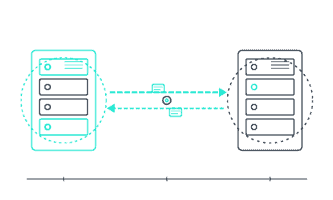
Your platform can consume webhook events from your systems in real time, triggering automated actions the moment an order status changes, a payment clears, or a hold is applied or released.
 RESTful (Representational State Transfer) API Endpoints
Your platform exposes RESTful endpoints for your systems to query directly, enabling account lookups, status checks, and data retrieval on demand from your existing tooling without custom middleware.
 SFTP (Secure File Transfer Protocol) Synchronization
For institutions with batch-oriented core systems, scheduled SFTP-based file exchange ensures automation fits your existing data delivery cadence without requiring real-time connectivity.
A fully managed issuing-party network, so your IT team doesn’t have to build and maintain it.
Instead of managing dozens of one-off integration projects with agencies, law firms, and law enforcement, your institution can connect to a fully managed network of serving parties. Your vendor handles issuing-party support and maintenance, eliminating ongoing integration burden from your internal teams and enabling faster scaling with lower risk.
FOR IT & OPERATIONS TEAMS
- No bespoke integration builds per agency or law firm
- Your vendor maintains all issuing-party connections and format updates
- Supports webhook, RESTful API, and SFTP to flex to your stack
- Custom workflows supported beyond standard use cases
- Real-time data sharing for BSA compliance and transaction monitoring
FOR COMPLIANCE & REPORTING
- Downstream reporting systems receive structured data automatically
- Backup automation ensures no gaps in regulatory documentation
- BSA data pushes are triggered and logged within the workflow
- Audit trails flow into your data warehouse without manual export
- End-to-end visibility from intake to response in one connected system
THE COMPLETE PICTURE Five components your system will need. One goal: 100% zero-paper.
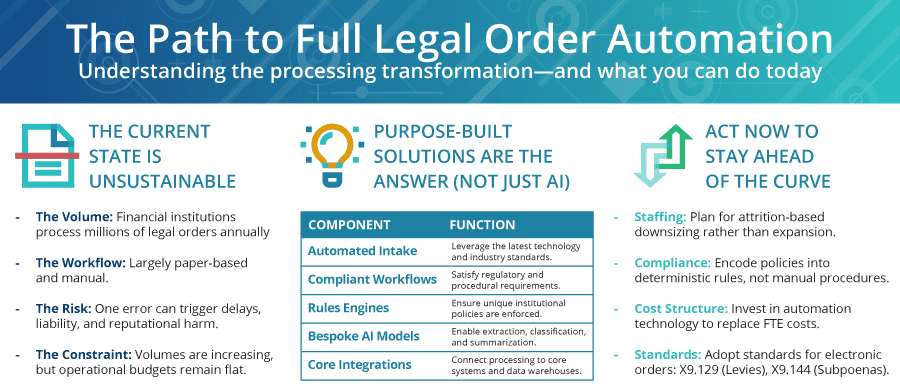
No single component delivers zero-paper automation on its own. Electronic intake feeds the AI models. AI models feed the compliant workflows. Workflows invoke the rules engines. Rules engines trigger the integrations. Together, all five components form a closed loop: a legal order arrives, is processed completely, and a legally compliant response is delivered without a human touching it.That is the vision of the X9 Legal Order Roundtable: not five isolated features, but one integrated approach purpose-built for the most demanding compliance workflows in financial services.
REQUEST TO JOIN THE LEGAL ORDER ROUNDTABLEAct Now—At No Cost—to Stay Ahead of the Curve
MEMBER BENEFITSAccess Exclusive Resources, Events, and Discussions
Despite the promise of AI, full automation will not happen overnight. It will require technological know-how, industry expertise, and a realistic roadmap. Understanding the X9B4 industry standards for electronic LEGAL ORDER (e.g., X9.129 and X9.144) will be crucial.HOW TO GET STARTEDConsider These Topics—Then Join the Conversation
- Staffing: Plan for attrition-based downsizing rather than expansion—even as volumes grow
- Compliance: Encode institutional policies into deterministic rules, not manual procedures
- Cost structure: Invest in automation (through technology solutions) to replace FTE costs
- What’s on your mind? Share your insights with the industry’s premier legal order community
Membership Quick Links
Membership Categories
X9 Fact Sheet & Membership Benefits
Membership Application