

ELECTRONIC INTAKE The foundation of zero-paper legal order processing
THE CHALLENGE Building an intake portal on your own
The intake process for legal orders remains one of the most fractured workflows in financial operations. Physical service happens across multiple locations (branches, headquarters, and registered agents), while PDF email attachments and faxes pile up alongside paper documents. Without electronic intake, every paper document creates manual work and introduces a risk of delay, loss, or error. ISSUE 1:Fractured Intake
Physical service, PDF email attachments, and faxes arrive across multiple locations with no unified intake and routing process.
ISSUE 1:Fractured Intake
Physical service, PDF email attachments, and faxes arrive across multiple locations with no unified intake and routing process.
 ISSUE 2:Compliance Exposure
Manual, high-volume workflows demand consistent policy application and fast turnaround. One mistake can result in motions to compel or legal liability.
ISSUE 2:Compliance Exposure
Manual, high-volume workflows demand consistent policy application and fast turnaround. One mistake can result in motions to compel or legal liability.
 ISSUE 3:Staffing Burden
Without electronic intake, large teams are required just to manage waves of paper documents, with no scalable path forward as volumes grow.
ISSUE 3:Staffing Burden
Without electronic intake, large teams are required just to manage waves of paper documents, with no scalable path forward as volumes grow.
THE SOLUTION What to look for in a two-way intake and response portal
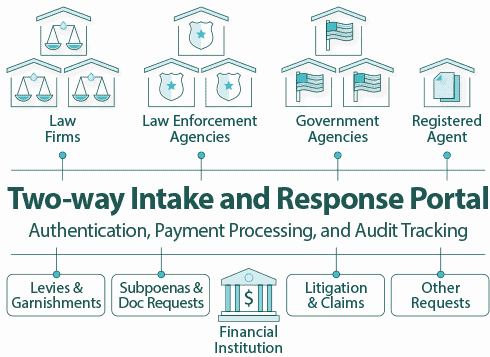
Companies are solving the intake problem with an intake portal: a secure, two-way intake and response platform that sits at the core of a connected network of agencies, firms, law enforcement, and registered agents.An intake portal enables legal service from all types of serving parties, while providing reliable and encrypted delivery of answers and responsive documents. It is designed not just to receive legal orders but to validate them: checking for duplicate submissions, validating jurisdiction, confirming service was on the correct entity, and flagging orders that require domestication.
KEY CAPABILITIES TO REQUIREWhat to look for when evaluating intake portals
FORMAT FLEXIBILITY Your portal should accept legal orders in any format
Many government agencies cannot generate LEGAL ORDER in the ANSI (American National Standards Institute)-approved X9.129 format. A well-designed intake portal meets them where they are, accepting X9, JSON, CSV, PDFs, or even fax, and uses AI to convert each submission into automation-ready structured data.This means your institution can rely on a single, standardized intake process that works nationally regardless of each agency’s technological maturity. The burden of format translation is eliminated, and every legal order arrives as clean, actionable data ready for downstream automation.
- X9.129 & X9.144: ANSI-standard structured electronic legal orders
- JSON & CSV: Machine-readable formats from modern agency systems
- PDF: Scanned or digitally generated court orders and levies
- Fax: Legacy transmission accepted and digitized automatically
- All formats: normalized to automation-ready X9.129 data via AI
WITHOUT an intake portal
- Dozens of one-off agency integrations to build and maintain
- Internal IT owns all agency support and maintenance
- Inconsistent formats require manual review before processing
- Paper and fax create delays and introduce error risk
- No standardized audit trail at point of intake
WITH an intake portal
- One fully managed, continuously growing national network
- All issuing-party relationships and support are managed externally
- Every format normalized to automation-ready data via Azure AI
- Instant, encrypted digital delivery for all serving parties
- Full authentication, payment processing, and audit tracking
WHY INTAKE IS THE FOUNDATION OF ZERO-PAPER AUTOMATION
Electronic intake is not just an efficiency play. It is the foundational layer upon which the entire path to 100% zero-paper automation is built. Without it, compliant workflows, deterministic rules engines, LLM (Large Language Model)-powered intelligence, and flexible integrations cannot deliver their full value.- Staffing: Reduce manual intake teams through electronic workflows; plan for attrition-based right-sizing rather than expansion
- Compliance: Intake validation rules enforce policy at the source, before orders enter your workflow
- IT efficiency: One managed network replaces dozens of one-off integration projects with no ongoing maintenance burden
- Scale: A growing network of agencies, law firms, and law enforcement expands your automation reach automatically
REQUEST TO JOIN THE LEGAL ORDER ROUNDTABLEAct now (at no cost) to stay ahead of the curve
MEMBER BENEFITSAccess exclusive resources, events, and discussions
Despite the promise of AI, full automation will not happen overnight. It will require technological know-how, industry expertise, and a realistic roadmap. Understanding the X9B4 industry standards for electronic LEGAL ORDER (e.g., X9.129 and X9.144) will be crucial.HOW TO GET STARTEDConsider these topics, then join the conversation
- Staffing: Plan for attrition-based downsizing rather than expansion, even as volumes grow
- Compliance: Encode institutional policies into deterministic rules, not manual procedures
- Cost structure: Invest in automation (through technology solutions) to replace FTE (Full-Time Equivalent) costs
- What’s on your mind? Share your insights with the industry’s premier legal order community
Membership Quick Links
Membership Categories
X9 Fact Sheet & Membership Benefits
Membership Application