

BESPOKE AI MODELS Classification, extraction, and summarization for legal orders
THE CHALLENGE Why generic AI falls short in legal order processing
Legal orders arrive in dozens of formats (scanned PDFs, faxes, structured X9.129 files, and unstructured court documents), each carrying critical data that must be captured accurately and acted upon without delay. Off-the-shelf AI models are trained on general text, not on the precise language of levies, subpoenas, garnishments, and court orders. The result is extraction errors, misclassifications, and compliance risk that cannot be tolerated at scale.
General-purpose AI is not sufficient for legal order processing. The documents are too specialized, the stakes too high, and the compliance requirements too precise. The only path to reliable automation is AI trained specifically on the legal orders your institution receives.
ISSUE 1:Inaccurate Extraction
Generic models misread legal terminology, miss jurisdiction-specific fields, and introduce data errors that cascade into compliance failures downstream.
ISSUE 2:Misclassification Risk
A subpoena routed as a levy, or a civil order treated as a criminal warrant, triggers the wrong workflow, wrong timeline, and potential legal liability.
ISSUE 3:Manual Review Bottleneck
Without reliable AI, every unstructured document requires human review before it enters the workflow. This eliminates the efficiency gains that automation promises.
THE SOLUTION Your LLMs should be trained specifically for legal orders
Your automation platform should deploy bespoke AI models trained on real legal orders: not aggregated customer data, but actual agency-provided documents specific to each document type and jurisdiction. These models are purpose-trained to classify, extract, and summarize the specialized content of levies, subpoenas, garnishments, and civil court orders.
This legal-domain training is what separates your purpose-built solution from general-purpose AI. Models trained on actual legal orders understand the structure of an X9.129 levy, the fields of a civil subpoena, and the language patterns of state and federal court orders; extraction is reliable, classification is accurate, and the path to zero-paper automation is real.
THREE CORE AI CAPABILITIES TO REQUIREWhat your bespoke legal AI should do in your workflow
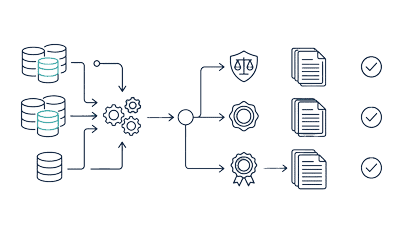 Classification
Identifies the legal order type (levy, subpoena, garnishment, civil order, or warrant) and routes it to the correct workflow automatically, without human triage.
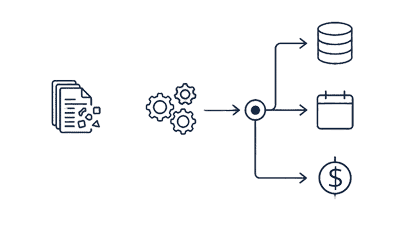 Extraction
Pulls structured data fields (account numbers, hold amounts, jurisdictions, deadlines, and issuing parties) from PDFs, faxes, and unstructured documents into automation-ready X9.129 format.
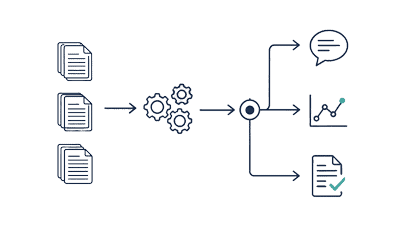 Summarization
Generates concise, human-readable summaries of complex legal orders for review queues, exception handling, and audit trails; this reduces the cognitive load on your team significantly.
THE HYBRID APPROACH Why your AI should be paired with deterministic rules
Your AI models should not operate alone. They work in tandem with deterministic rules engines: probabilistic AI handles the tasks where inference adds value (classification, extraction, summarization), while hard rules govern the decisions where compliance precision is non-negotiable (exemption logic, hold amounts, response deadlines).This hybrid architecture is the core of any reliable legal order automation approach. Your AI enhances throughput; your rules protect compliance. Neither replaces the other.
- AI classifies the document type and routes to the appropriate compliant workflow
- AI extracts structured data fields from any format, normalized to X9.129
- Rules engines apply your institution’s specific compliance policies with precision
- AI summarizes complex orders for your exception-handling queue
- All data remains in your secure environment; it is never pooled or shared
PRIVACY: What to require by design
- All training data remains localized to each customer environment
- Customer data is never used to train shared or global models
- AI capabilities operate exclusively within your institution’s context
- Data stays inside your institution’s secure cloud infrastructure
- No pooling, exporting, or reuse that could compromise confidentiality
ROADMAP: Expanding AI coverage
- Classifying unstructured civil court orders and ISRNs (Information Subpoenas with Restraining Notice)
- Identifying exempt funds from ACH (Automated Clearing House) transaction patterns
- Applying exemption logic to calculate seizure amounts
- Redacting sensitive data from responsive documents
- Generating draft responses for legal review and approval
WHY AI IS THE ENABLER OF ZERO-PAPER AUTOMATION
Bespoke AI models are the intelligence layer that converts raw legal order data into actionable, automation-ready inputs. Without accurate classification and extraction, compliant workflows cannot run reliably, rules engines have nothing to act on, and zero-paper automation remains out of reach.
Your AI should already be automating form classification, data capture, and conversion to X9.129 format. This eliminates manual data entry for high-volume levy workflows and lays the groundwork for full zero-paper legal order response.
- Staffing: Eliminate manual data entry and document triage; redirect your team to exception handling and compliance oversight
- Accuracy: Domain-trained models reduce extraction errors, misroutes, and the compliance risk that follows
- Scale: AI processes every document at intake speed, without fatigue or variance. Volumes grow without adding headcount
- Roadmap: Each new AI capability extends zero-paper automation further into the workflow, toward 100% automated legal order response
REQUEST TO JOIN THE LEGAL ORDER ROUNDTABLEAct now (at no cost) to stay ahead of the curve
MEMBER BENEFITSAccess exclusive resources, events, and discussions
Despite the promise of AI, full automation will not happen overnight. It will require technological know-how, industry expertise, and a realistic roadmap. Understanding the X9B4 industry standards for electronic LEGAL ORDER (e.g., X9.129 and X9.144) will be crucial.HOW TO GET STARTEDConsider these topics, then join the conversation
- Staffing: Plan for attrition-based downsizing rather than expansion, even as volumes grow
- Compliance: Encode institutional policies into deterministic rules, not manual procedures
- Cost structure: Invest in automation (through technology solutions) to replace FTE (Full-Time Equivalent) costs
- What’s on your mind? Share your insights with the industry’s premier legal order community
Membership Quick Links
Membership Categories
X9 Fact Sheet & Membership Benefits
Membership Application